Monumenti · Capoterra
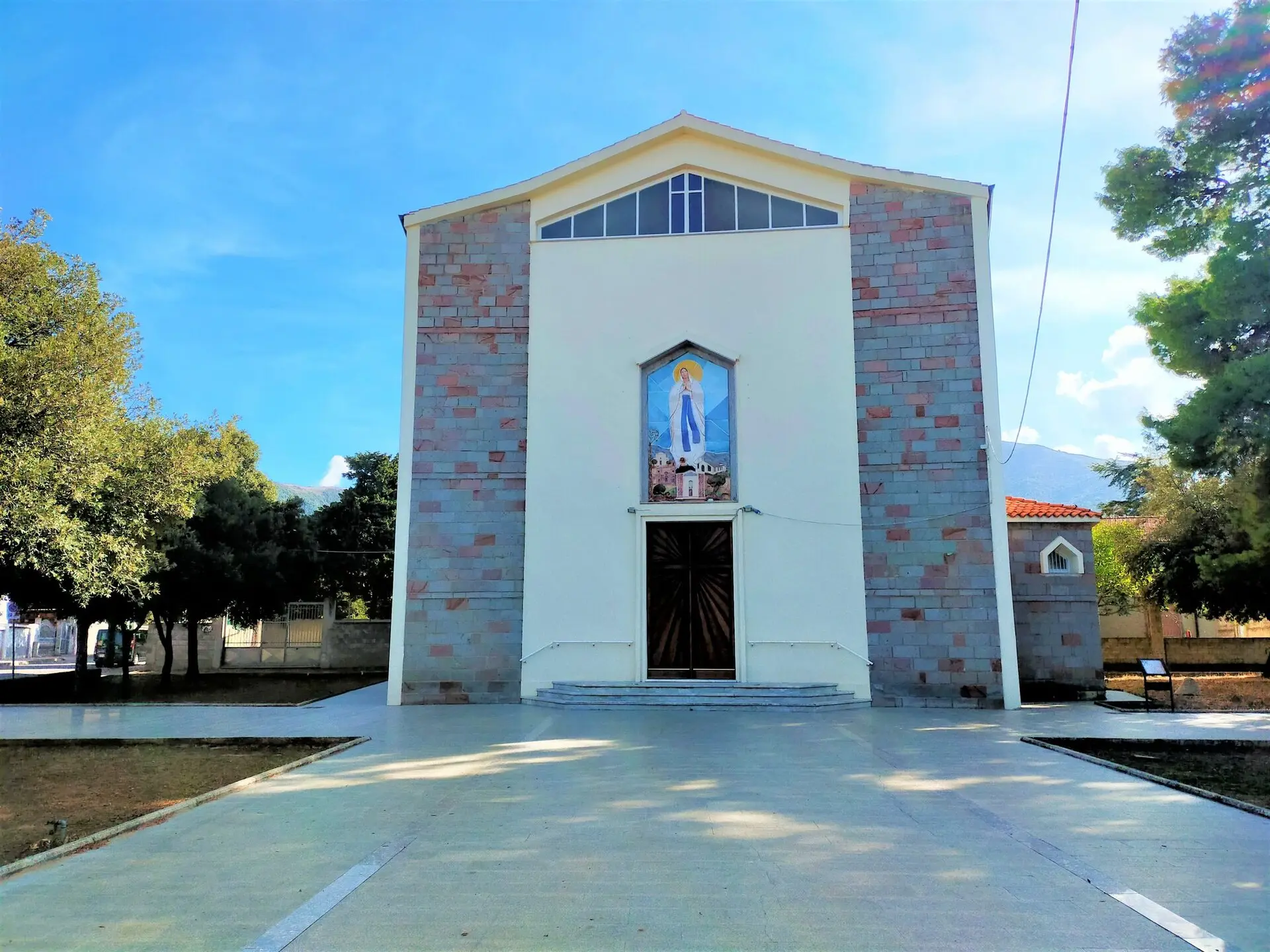
The Parish Church of Poggio dei Pini
Contemporary architecture and sacred symbolism
The church of the Madonna di Lourdes at Poggio dei Pini has a circular floor plan, designed by engineer Giorgio Diaz between 1989 and 1997. The layout stems from the liturgical reform of the Second Vatican Council: the faithful sit around the altar, no longer separated from the priest. Every architectural element has a precise numerological meaning.
Architecture and conciliar renewal
The parish of the Madonna di Lourdes was canonically established on 1 January 1985. The construction of the new church, designed by engineer Giorgio Diaz, began on 19 February 1989 and concluded with its consecration on 9 February 1997.
The Second Vatican Council (1962–1965) had reformed the liturgy: the priest now celebrated facing the people, with the altar as the centre of the community. No longer the long nave separating the priest from the faithful, but a space that gathered them around the Eucharist.
Diaz chose a circular floor plan: the Church as domus Dei, the house of God among humanity. Every worshipper is equidistant from the altar. The design is inspired by Matthew 13:52: the master of the house who brings from his treasury "things new and old".
Numerological symbolism
The architecture is built on a system of 12 symbolic numbers. Every structural element incorporates at least one:
- 1 — the oneness of God. One altar, one tabernacle, one baptistery
- 2 — the two natures of Christ (human and divine). Two entrance doors
- 3 — the Trinity. Three steps to the altar, three windows in the presbytery
- 4 — the four Evangelists. Four load-bearing pillars
- 5 — the five wounds of Christ
- 6 — the six days of Creation
- 7 — the seven Sacraments. Seven lamps
- 8 — the Resurrection (the eighth day). The baptistery is octagonal
- 9 — the nine choirs of angels
- 10 — the Ten Commandments
- 11 — the faithful Apostles (twelve minus Judas)
- 12 — the twelve Apostles. Twelve columns in the ambulatory
Structural symbolism
Every architectural element carries a theological meaning:
- The circular floor plan — the Church as the Body of Christ, a community without end or beginning
- The octagonal baptistery — eight as the number of the Resurrection and new life
- The cross-shaped baptismal font — Baptism as death and resurrection with Christ
- The floor — in local stone, a symbol of the Sardinian earth in which the community is rooted
- The stained-glass windows — light as a metaphor for the Grace entering the sacred space
- The crucifix — suspended above the altar, the focal point of the assembly
Things new and old
The church preserves elements recovered from the local territory. A basalt slab from the Su Loi church has been reused in the floor. An 18th-century wooden cross, saved from the old church, is displayed in the nave. Fragments of medieval pottery and worked stone are embedded in the structure.
The large stained-glass windows open onto the vegetation of Poggio dei Pini. Natural light, filtered through the coloured glass, changes with the hours of the day and the seasons.
Informazioni
Indirizzo: Via S. Bernadette Soubirous, 3 — Poggio dei Pini
Progetto: Eng. Giorgio Diaz
Costruzione: 1989–1997
Pianta: Circular, inspired by the renewal of Vatican II
Source: Monumenti Aperti fact sheets, texts by Mauro Dadea, graphic design by Marco Frau, 2007.