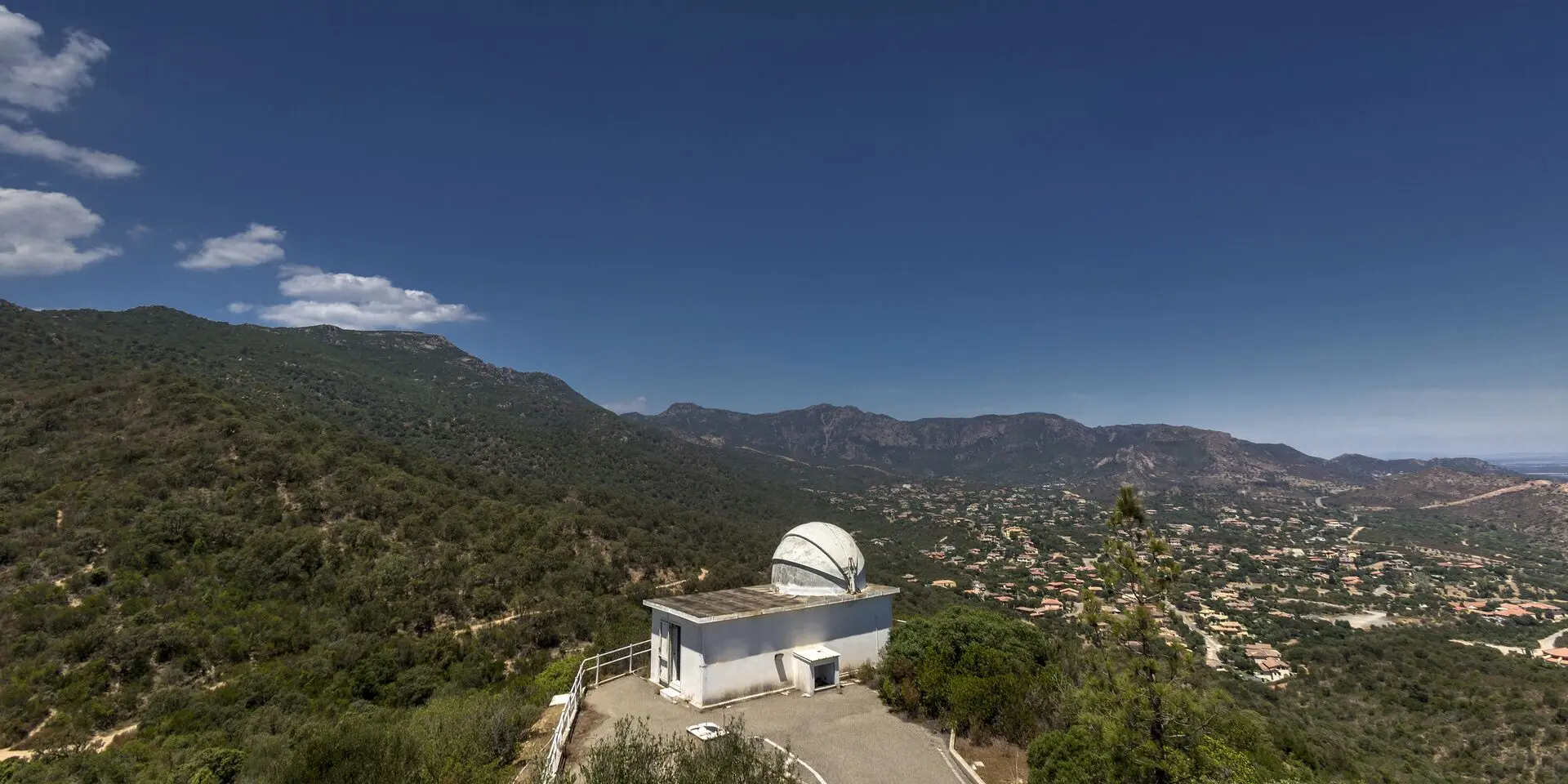
The Territory
Capoterra (in Sardinian Cabuderra) stretches along the south-western coast of Sardinia, just 15 kilometres from Cagliari, overlooking the western arm of the Gulf of Angels. The name comes from the Latin Caput Terrae — "head of the land" — because it was the first land encountered after the Santa Gilla lagoon when approaching from Cagliari.
With over 23,000 inhabitants spread across 68.49 km², the territory is divided into three areas: the historic hillside centre at the foot of the Montarbu and Monte Arrubiu hills, the coastal strip developed from the 1960s onwards, and the hilly residential area of Poggio dei Pini. From the heights, the panorama sweeps from the Sulcis mountains to the sea, taking in the lagoon and the Campidano plain.
History
Capoterra's origins reach back into prehistory. At Cuccuru Ibba, a Neolithic flint workshop and the remains of circular huts have been uncovered. The Nuragic period left traces at Baccu Tinghinu and in the nuraghe of Monti Arrubiu, while the Punic settlement of Su Loi and the necropolis of Sant'Antonio (5th–4th century BC) bear witness to a Carthaginian presence.
A Roman oppidum grew up near the lagoon. During the Middle Ages Capoterra was a village of the Giudicato of Cagliari, contested between Pisans and Aragonese. In 1353 Judge Mariano IV ordered its destruction; the territory remained uninhabited for three centuries.
The revival came on 9 May 1655, when Baron Girolamo Torrelas refounded the settlement under the name "Villa di Sant'Efisio", drawing families from the Logudoro and Gallura regions. In 1840 Carlo Alberto abolished feudalism and Capoterra became an independent municipality.
An important industrial chapter: in 1862 the first railway in Sardinia was inaugurated — a narrow-gauge line of 14.5 km linking the San Leone mine to the port of Maramura. In 1858 the French engineer Gouin had acquired the Baccu Tinghinu estate, where in 1865 he planted what is considered the oldest eucalyptus tree in Sardinia.
Nature & Parks
Capoterra's territory harbours extraordinary biodiversity, from coastal wetlands to mountain forests.
Parco di Gutturu Mannu
On the highlands stretches the Gutturu Mannu Park, home to the largest holm-oak forest in the Mediterranean — nearly 4,000 hectares of unbroken woodland of holm oaks, cork oaks and heather. The trails wind through deep gorges and natural springs, in a landscape with no equal in Europe.
Stagno di Santa Gilla
At the foot of the town lies the Santa Gilla Lagoon, one of the most important wetlands in Europe. Here lives a resident colony of pink flamingos, alongside herons, cormorants, coots and terns. The CEAS Casa Spadaccino (Environmental Education Centre) organises educational trails and excursions to explore this unique ecosystem.
Oasi WWF di Monte Arcosu
In the neighbouring territory, the WWF Oasis of Monte Arcosu protects the Sardinian deer — an endemic subspecies saved from extinction through decades of conservation. The Mediterranean scrub also shelters wild boar, foxes, martens, golden eagles and peregrine falcons.
Beaches & Sea
The coast of Capoterra and the nearby shores offer some of the finest beaches in southern Sardinia.
- Spiaggia della Maddalena (Lido di Capoterra) — the beach closest to the town centre, with facilities and the Cayo Loco beach club
- Chia — 20 minutes away, famous for its crystal-clear waters and sand dunes
- Su Giudeu — a sheltered bay with a small islet reachable on foot
- Tuerredda — a wild cove among the most photographed on the island
- Nora — beach next to the Phoenician-Roman archaeological site
- Costa di Teulada — stretches of unspoilt coastline with spectacular contrasts
Monuments & Places
Churches
- Parish Church of Sant'Efisio (1855–1858) — the main building in the historic centre, dedicated to the patron saint
- Church of Santa Barbara de Montes (1281) — a gem of Romanesque-Pisan style on the heights, where according to legend the Saint was beheaded. Where her head fell, the spring of Sa Scabizzada sprang up
- Church of San Girolamo (1615) — built by the Hieronymite friars
- Stational church of Su Loi — a stop on the Sant'Efisio procession on 1 May
Historic buildings
- Casa Melis — a Liberty-style residence completed in 1920, among the most notable civic buildings
- Casa Spadaccino — former mining station, now home to the CEAS (Environmental Education Centre)
- Villa Gouin — French estate with period furnishings and the library containing original sketches by Lamarmora
Other places
- Astronomical Observatory — at Poggio dei Pini
- Military forts of Pauliara — historic fortifications
- Torre di Su Loi — coastal watchtower
- Saline Conti Vecchi (FAI) — the oldest saltworks in Sardinia, visitable by guided tour on a small train
Traditions & Culture
Community life in Capoterra is marked by religious festivals and age-old traditions.
Main festivals
- Sant'Efisio (15 January) — feast of the patron saint. On 1 May the procession from Cagliari to Nora stops at the church of Su Loi
- Santa Barbara (first week of July) — rural festival with procession to the Romanesque church on the heights
- Monumenti Aperti — Capoterra takes part in the regional event with the special opening of churches, historic houses and archaeological sites
Folklore
The folk groups S'Attobiu and Sa Scabitzada keep traditions alive with performances of typical Sardinian dances in traditional costume and polyphonic choir. The name "Sa Scabitzada" (the beheaded one) recalls the legend of Santa Barbara and the miraculous spring that appeared where her head fell.
Sources: Wikipedia, Città Metropolitana di Cagliari, GeoSardGIS, Monumenti Aperti, Isola Sarda, Gent'Arrubia. Information drawn from public sources and verified against multiple references.