Monumenti · Capoterra
Sant'Efisio at Su Loi
Roman villa, stational chapel and the 1 May procession stop
At Su Loi lie the remains of a late imperial Roman villa with baths and mosaics, a 17th-century stational chapel, and every 1 May the Capoterra stop of the Sant'Efisio procession on its way to Nora.
The Roman villa
The remains of the late imperial villa at Su Loi were identified by archaeologist Gennaro Pesce in the 1950s. The excavations revealed a residential complex with baths equipped with mosaic floors, pools, water conduits and heated rooms.
The settlement was already active in the Punic period (5th–4th century BC), judging by the ceramic materials found. In Roman times it became a villa rustica, a country estate on the plain near the lagoon. It stood along the Roman road Cagliari–Nora, so it also served as a staging post.
Today the remains are partly incorporated into the Ferraris farm estate. Mosaic fragments, concrete opus walls and traces of pavements are still visible, though not publicly presented.
The chapel
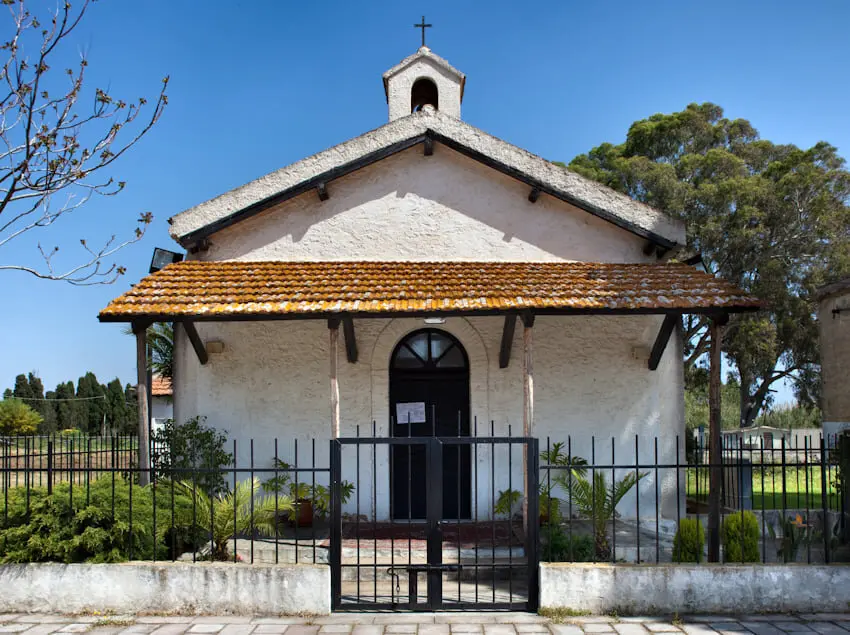
The stational church of Sant'Efisio at Su Loi is simple: a single nave with timber roof trusses. It stands next to the remains of the Roman villa and may reuse ancient materials in its foundations.
Its function is to serve as a stop for the Sant'Efisio procession: on 1 May, the cortège from Cagliari halts here before continuing towards Nora. Inside, an altar with the statue of the Saint and a few pews.
The Ferraris farm estate, which owns the surrounding land, collaborates in the organisation of the festival by providing spaces for the pilgrims, the horses and the traccas (the decorated carts).
The Saint and the procession
The procession of Sant'Efisio began in 1657, one year after the plague that decimated Cagliari. The city made a vow to the Saint: an annual procession in exchange for the end of the epidemic. The vow has never been broken, not even during the World Wars.
The route starts from the church of Sant'Efisio at Stampace (Cagliari) on the morning of 1 May. The procession moves through the city on a gilded carriage drawn by oxen, accompanied by hundreds of faithful in Sardinian costume, horsemen, coachmen, flower-decked traccas and folk groups. At Su Loi the procession makes its Capoterra stop: a halt for the blessing, the refreshment of pilgrims and prayer.
The procession then continues towards Pula and Nora, where the Saint was martyred in 303 AD. The return to Cagliari takes place on 4 May with the same solemnity as the outward journey.
The festival
The organisation of the festival at Su Loi is entrusted to the Guardiania — a volunteer committee that renews itself every year. The head of the Guardiania, elected by the community, coordinates the preparations: setting up the chapel, preparing the communal meal, welcoming the pilgrims.
At 8.15 on the morning of 1 May, the Third Guardian accompanied by the Guardiania sets out on horseback to meet the procession. Around 9.30, the Saint arrives at Su Loi accompanied by coachmen, horsemen and traccas. The religious ceremony takes place in front of the chapel, followed by the communal meal.
The Guardiania returns to Capoterra on the Saturday before the feast, with a ceremony that includes the blessing of the horses and a parade through the village streets. The Miliziani — participants in historical military costume — accompany the celebrations. Folk groups perform traditional dances in the square.
Around noon the procession sets off again towards Pula, with the Guardiania accompanying the Saint to the border of Capoterra's territory. The festival continues with music, food and celebrations until evening.
Informazioni
Posizione: Locality Su Loi, along the SS 195
Epoca: Roman villa (1st–5th c. AD), chapel (17th c.)
Festa: 1 May (Sant'Efisio procession)
Gestione: Annual Guardiania with volunteer committee
Source: Monumenti Aperti fact sheets, texts by Mauro Dadea, graphic design by Marco Frau, 2008.