Monumenti · Capoterra
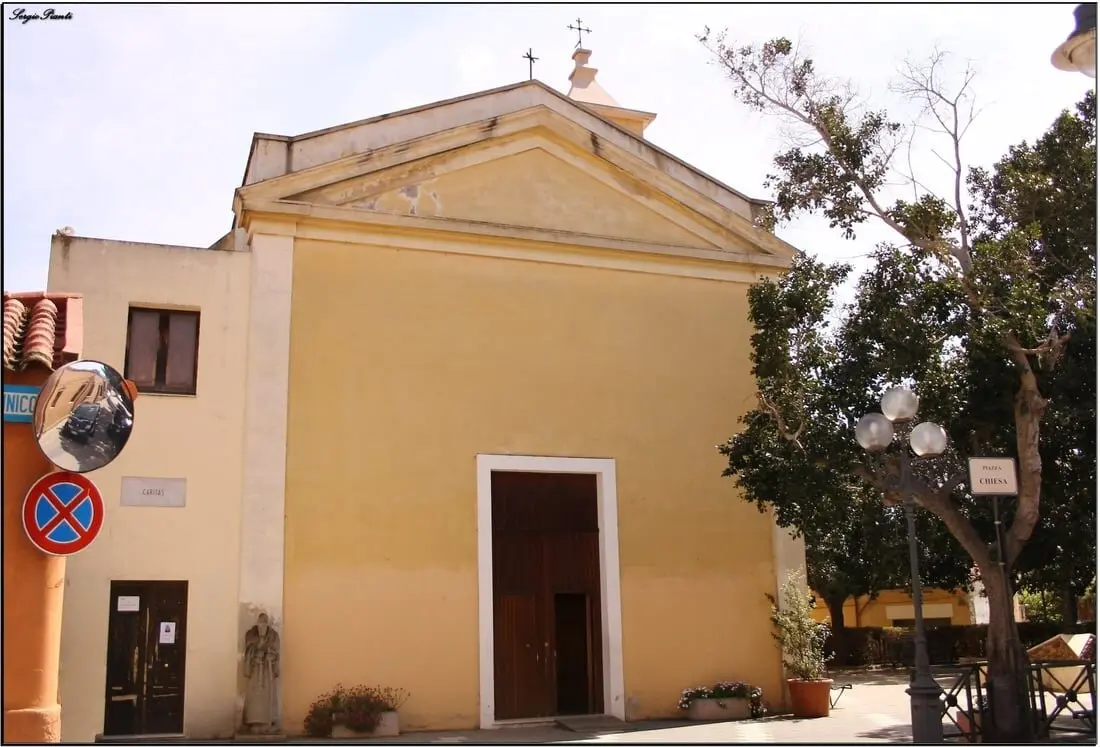
Church of Sant'Efisio
Capoterra's parish church and its patron saint
Capoterra's parish church was rebuilt in 1855. The first altars, columns and old façade were redone in Piedmontese style, an aesthetic choice that broke with the previous Sardinian-Catalan traditions.
The church
Capoterra's first church was a baronial chapel erected in 1655 at the time of the refoundation. Too small for the growing population, it was enlarged in the 18th century. But structural problems persisted: walls too thin, precarious roofing, water infiltration.
In 1855 it was decided to build a new church. The foundation stone was laid on 12 April 1855, but on 5 October the load-bearing arches collapsed and much of the structure had to be rebuilt. The first Mass was celebrated in 1858.
A 1910 episcopal letter describes it as built "without conscience", already too small for a population grown beyond 3,500. The bell tower, built separately, houses the main bell cast in 1898. The flood of that same year severely damaged the structure and the adjacent parish house.
The current façade, plastered white with stone cornices, is the result of successive interventions. The front is simple: an entrance portal surmounted by a niche with the statue of the Saint. The streets damaged by the flood of 24 November 1898 were repaired in the following months.
The Saint
Sant'Efisio is among the most venerated saints in Sardinia. An Eastern-born Roman soldier (possibly from the city of Elia, in modern Turkey), he was an imperial army officer sent to the island to persecute Christians. During the journey he had a vision that converted him to the Christian faith.
Arrested for refusing to renounce his faith, he was beheaded on 15 January 303 AD at Nora, during the Diocletianic persecutions. In 1656, during the plague in Cagliari, the city made a vow to the Saint; since then, every 1 May a procession crosses Capoterra heading towards Nora.
The statue in the parish church depicts him in the garb of a Roman warrior, bearing the banner of the faith. Capoterra's iconography favours the image of the miles Christi, the soldier of Christ.
Furnishings and cults
The church preserves several polychrome wooden statues from the 18th and 19th centuries:
- San Giovanni Battista — 18th-century wooden statue, depicted with the lamb
- Santa Lucia Vergine e Martire — with the dish and the eyes, attributes of her martyrdom
- Beata Vergine Assunta — processional statue
- San Giuseppe Sposo and San Giuseppe Marcello
- Santa Rita da Cascia
- Sant'Ignazio da Laconi
- San Girolamo Presbitero — linked to the Hieronymite friars
- Santa Barbara V.M. Cagliaritana — processional statue brought from the country church
Among the church's furnishings appears Santa Barbara Vergine e Martire Cagliaritana. Tradition "doubles" the figure: there is the "official" Barbara (Nicomedia) and the local Barbara, martyr of Capoterra's heights. This devotional overlap is not found in any other Sardinian village.
Then and now
Historical photographs of the church, compared with present-day ones, show how much the historic centre has changed. The old churchyard, the low houses around the square, the isolated bell tower: everything is recognisable, yet everything is different. The 20th-century processional statue of Santa Barbara, in polychrome papier-mâché, is still carried in procession on 15 January.
Informazioni
Epoca: 1655 (baronial chapel), 1855–1858 (current church)
Patrono: Sant'Efisio (15 January)
Posizione: Piazza della Chiesa, historic centre
Processione: 1 May (stop at Su Loi on the way to Nora)
Source: Monumenti Aperti fact sheets, texts by Mauro Dadea, graphic design by Marco Frau, 2007.