Monumenti · Capoterra
Church of Santa Barbara
Romanesque-Pisan church of 1281 on the heights of Capoterra
The oldest church of Santa Barbara in Sardinia stands on the slopes of the eponymous hill, above the built-up area of Capoterra. Its foundation is documented in an inscription of 1281, locating it in the countryside of Capoterra, at the time part of the curatoria of Nora in the Giudicato of Cagliari.
The exterior
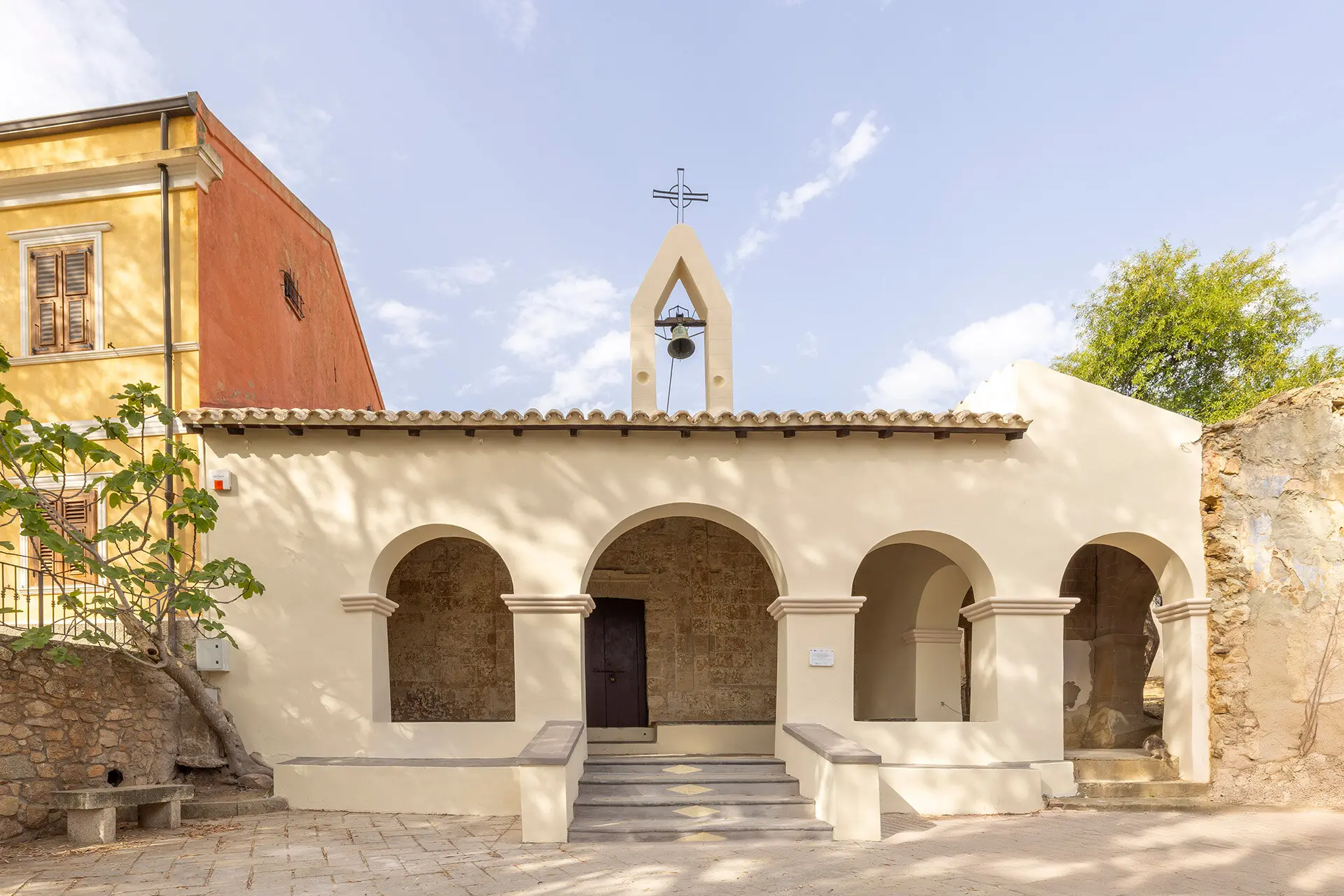
The building has a rectangular plan with a gabled façade, following the canon of Tuscan Romanesque transplanted to Sardinia by the Pisans. The façade is crowned by a bell gable with two arched openings, and articulated by hanging arches and pilasters that create a play of light and shadow on the wall surface.
Set into the façade are polychrome ceramic basins: proto-maiolica from Brindisi dating to the 13th century and pottery with Islamic geometric decoration from North Africa. Such "basins" were typical of Pisan churches — small bowls embedded in the façade that reflected light. Some originals have been removed for conservation and replaced with replicas.
The entrance portal has a monolithic lintel surmounted by a round-arched lunette. The masonry is in limestone and sandstone ashlars laid in regular courses. On the south side a splayed single-light window illuminates the interior.
Between the late 16th and early 17th centuries, the Conventual Friars Minor of San Francesco di Stampace in Cagliari probably gained possession of the church. It is not unlikely that during this period the church of Santa Barbara, along the Karralizza route (the current road to Capoterra), was used as a rest stop and refreshment station for travellers.
The interior
The single nave, roofed with timber trusses, is intimate and austere. The plastered walls are articulated by pilasters and small arches. The apse, oriented east, holds the high altar with the statue of the Saint.
The interior has undergone numerous transformations. In 1862 and 1998 the Soprintendenza consolidated the walls, restored the roof trusses and uncovered original elements hidden under later plaster. The marble holy water font, probably medieval, is among the oldest pieces preserved inside.
The first rector of the Sant'Efisio parish church, don Atzori, had several statues transferred from the country church to the parish church around 1862, including a wooden carved Crucifix.
The Saint
The cult of Santa Barbara Virgin and Martyr of Cagliari is attested at Capoterra from the mid-16th century. She is a local saint — distinct from the better-known Santa Barbara of Nicomedia — whose story is steeped in legend and mystery.
According to tradition, Barbara was the daughter of a wealthy pagan from Cagliari. Having converted to Christianity, she was tried and condemned to death by her own father, who beheaded her with his own hands on the heights of Capoterra. Where her head fell, a spring miraculously appeared.
The oldest lapidary inscription concerning her, dated 1624, reads: "S. BARBARA V. ET M. Q. VIXIT ANNIS XXX" — Santa Barbara Virgin and Martyr who lived thirty years. Another inscription in the church describes her as "Cagliari-born Virgin Martyr". The Saint's relics were discovered on 23 June 1621 according to a document in the episcopal archive.
The Capuchin friar Ferreli, in his 17th-century studies, identifies Barbara as a martyr of the Diocletianic period (3rd–4th century). Popular tradition has overlaid elements of the Eastern legend (the tower, the lightning bolt) with local ones (the martyrdom on the heights, the spring). The result is a cult with no parallels in any other Sardinian village.
The spring of Sa Scabizzada
A few hundred metres from the church, amid the vegetation, lies the spring of Sa Scabizzada, "the beheaded one" in Sardinian. Tradition holds that it sprang forth where the head of Santa Barbara fell.
The structure is in stone, with a barrel vault sheltering two small chambers. The water, collected in a basin, was believed to be effective against eye ailments. Pilgrims from across the Cagliari area came to wash their faces with the spring water.
On the walls are votive tablets with the image of Martin Capoterra, ex-votos from the 17th to 19th centuries. The spring was frequented as a sacred site well into the 20th century.
Today the spring is abandoned. The masonry needs consolidation, vegetation has invaded the access paths, and the water is no longer usable. Restoration is needed.
Informazioni
Epoca: 1281 (documented inscription)
Stile: Romanesque-Pisan
Posizione: Heights of Santa Barbara, above the town centre
Restauri: 1862, 1998 (Soprintendenza)
Festa: First week of July
Source: Monumenti Aperti fact sheets, texts by Mauro Dadea, graphic design by Marco Frau, 2007.